Two Roles for the Appetites
Insane masters in Book 1 of the Republic, founders of the city in Book 2.
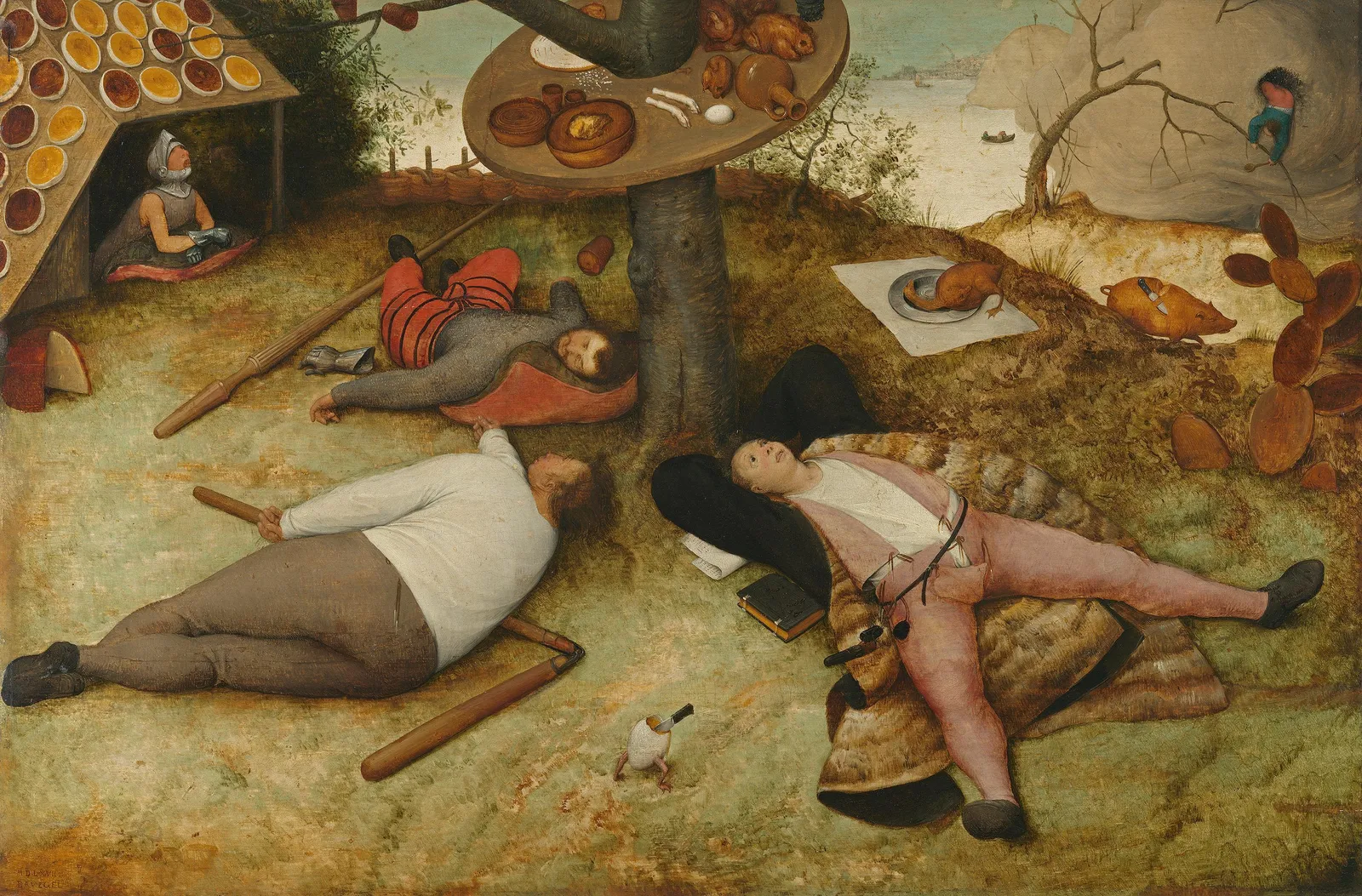
In Books 1 and 2 of the Republic, the appetites are presented in two distinct roles. First, through a conversation with Cephalus, they are depicted as “insane masters,” potential sources of injustice, whose taming is required for a peaceful life (329a–e). Second, in the founding of the first city, the same appetites are the foundations of both the healthy and the luxurious, feverish city (369a–374a).
Answering Socrates’ question about the experience of becoming and being old,1 Cephalus introduces the first role of the appetites. His response is given in contrast to his friends’ lamentations and longings “for the lost pleasures of their youth.” For them, old age is a state of deprivation, defined by the loss of appetitive pleasures. Cephalus, however, thinks they are wrong. He quotes Sophocles approvingly: “I am very glad to have escaped from all that, like a slave who has escaped from a deranged and savage master.” For Cephalus, only the ceasing of the appetites can bring “peace and freedom.” The true cause of his friends’ misery, he argues, is not old age but “the way people live.” If people are “orderly and contented,” old age is “only moderately onerous”; if they are not, “both old age and youth are hard to bear” (329c). This first conception treats the appetites as inherently disruptive forces that must be overcome or transcended for one to live well.2
Yet when Socrates begins constructing the healthy city with Adeimantus, the appetites take on an entirely different role. The city owes its very existence to appetitive needs: “a city comes to exist, I believe, because none of us is individually self-sufficient, but each has many needs he cannot satisfy.” These initial needs (food, shelter, clothing) are fundamentally appetitive. Moreover, they are the driving force behind human association and cooperation: “Then because we have many needs […] we gather many into a single settlement as partners and helpers” (369c). The appetites here have become the generative force of political community itself.
This second role becomes more complex as Glaucon objects to the healthy city, calling it a simple “city of pigs,” and demands “relishes and desserts.” Socrates thinks the healthy city is the true city, but accepts Glaucon’s demand for a city that provides more than just the necessities, acknowledging that many won’t be satisfied with the healthy city, and hoping that “by examining such a city, we might perhaps see how justice and injustice grow up in cities” (372e). This expansion is driven entirely by appetite, and requires new professions to satisfy it. Its citizens, having overstepped “the limit of their necessary desires,” will inevitably seize their neighbors’ land, leading to war. This conflict in turn necessitates the establishment of the guardian class. Thus the appetites reveal their dual nature: they are the creative force behind social structure; and yet, when unlimited, they are the source of “the greatest evils for cities and the individuals in them” (373e). This paradox, that the same force enabling political community also threatens to destroy it, becomes the central problem the remainder of the Republic must be dedicated to solving.
Written in September 2025 for a graduate seminar in ancient philosophy at the University of Rochester; lightly edited for the web.
Thoughts, objections, praise or condemnation? Email me.
Notes
- Socrates: “[…] like people who have traveled a road that we too will probably have to follow […] Is it a difficult time of life? What do you have to report about it?” (328e). ↩
- It also seems that Thrasymachus’ view of justice as profiting rests on defining justice in relation to the satiation of one’s appetites. A thread for another time. ↩
References
- Plato. Republic. Translated by G. M. A. Grube, revised by C. D. C. Reeve. Indianapolis: Hackett, 1992. Stephanus numbers in parentheses refer to this edition.